

Beyond Interoperability: Why Longitudinal Patient Profiles Are Becoming Foundation of Healthcare Intelligence
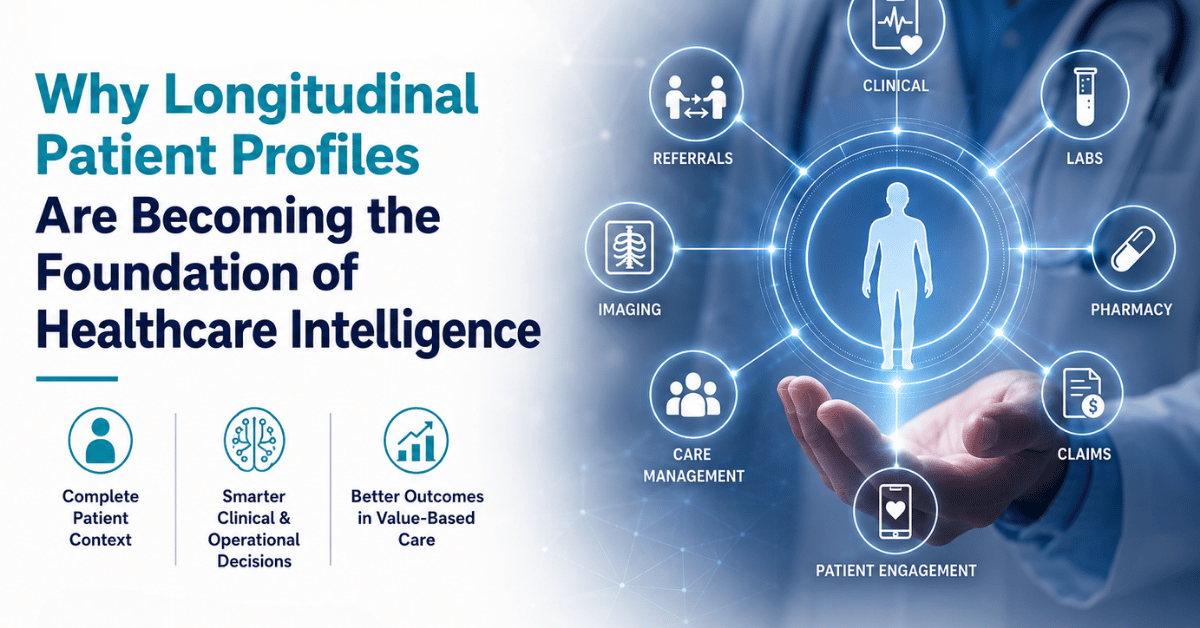
Longitudinal patient profiles unify clinical, claims, referral, care management, and patient engagement data to power Healthcare Intelligence and improve value-based care.
Interoperability connected healthcare data. Longitudinal patient profiles now transform that data into Healthcare Intelligence for value-based care.
SOUTH PLAINFIELD, NJ, UNITED STATES, July 22, 2026 /EINPresswire.com/ -- The healthcare industry has made significant progress in interoperability. Electronic Health Records (EHRs), laboratory systems, imaging platforms, pharmacies, payer networks, and care management applications can now exchange information more efficiently than ever before. Standards such as HL7, FHIR have accelerated connectivity across the healthcare ecosystem, enabling organizations to access information that was once locked within isolated systems.The urgency is reflected in the industry's direction. According to CMS, accountable care initiatives now support care for more than 11 million people through the Medicare Shared Savings Program (MSSP), underscoring the growing emphasis on coordinated, longitudinal care and outcomes across the U.S. healthcare system.
For healthcare providers, this transformation has fundamentally improved the availability of information. Yet as value-based care becomes the operational model for managing populations, a new question is emerging. Once information is connected, how can it be transformed into a complete understanding of the patient that supports every clinical and operational decision?
According to Equipo Health, answering that question represents the next stage of healthcare's digital evolution.
Interoperability Changed How Information Moves
The first phase of digital transformation focused on eliminating barriers to information exchange. The objective was to enable physicians, hospitals, specialists, laboratories, pharmacies, and health plans to share patient information securely and efficiently. That objective has largely been achieved.
Today, providers have access to an unprecedented volume of healthcare data originating from multiple sources. Clinical documentation captures diagnoses and treatment plans. Administrative and claims data provide visibility into services delivered across organizations. Referral networks reveal how patients move through the continuum of care. Care management documentation records interventions outside the traditional clinical encounter, while patient engagement platforms and remote monitoring technologies contribute insight long after a visit has ended. Each source delivers valuable information. Together, they represent something far more important than individual records, they reflect the patient's ongoing healthcare journey.
The Challenge Is No Longer Data Availability
Healthcare organizations rarely struggle because information does not exist. The greater challenge is ensuring that information remains connected as patients move across care settings, providers, and programs.
A patient may receive preventive care from a primary care physician, specialty treatment from multiple consultants, post-acute services following hospitalization, medication support from a pharmacy, and ongoing outreach from care management teams. Every interaction contributes meaningful clinical and operational context.
However, these interactions often originate from different workflows, different systems, and different organizations. Without a mechanism to continuously preserve patient context, care teams spend valuable time assembling information before they can determine the next appropriate action.
As healthcare increasingly emphasizes outcomes over individual encounters, continuity becomes just as important as connectivity.
From Connected Records to Longitudinal Patient Context
Patients experience healthcare as a continuous journey. Technology should reflect that same continuity.
A longitudinal patient profile is more than a consolidated record. It is a dynamic representation of the patient's health over time, continuously enriched by every meaningful interaction across the care continuum. Clinical observations, referrals, quality measures, claims activity, care coordination, patient-reported information, and engagement history each contribute another layer of understanding.
This approach shifts the focus from where information was created to how it contributes to the patient's current condition.
Instead of navigating multiple applications to reconstruct a timeline, providers gain a comprehensive view that evolves as care progresses. The emphasis moves from retrieving information to understanding relationships, identifying changes, and recognizing opportunities for timely intervention.
For multidisciplinary teams, this shared understanding strengthens collaboration because every participant works from the same clinical and operational context rather than separate fragments of information.
Healthcare Intelligence: The Next Layer of Digital Transformation
As interoperability becomes increasingly mature, healthcare organizations are beginning to evaluate technology differently. The conversation is shifting from whether systems can exchange information to whether they can preserve clinical context throughout the patient's journey. Equipo Health believes this shift represents the emergence of Healthcare Intelligence which has the ability to transform fragmented clinical, operational, administrative, claims, and patient engagement information into meaningful patient context . In practical terms, this enables organizations to identify patients requiring follow-up after hospital discharge, recognize emerging care gaps before quality measures are affected, prioritize outreach based on changing clinical needs, coordinate referrals more effectively, and maintain visibility throughout complex episodes of care. Rather than asking clinicians to assemble disconnected information, Healthcare Intelligence delivers a trusted foundation upon which informed decisions can be made.
Why This Matters in Value-Based Care
Value-based care measures success across the entire patient journey.
Organizations are expected to improve quality, strengthen patient engagement, manage chronic conditions, reduce avoidable utilization, and coordinate care across diverse provider networks. Achieving those objectives depends upon more than exchanging information between systems.
It requires maintaining a consistent understanding of every patient as their healthcare journey evolves. When patient context is preserved over time, providers gain a clearer understanding of changing risk, previous interventions, outstanding care needs, and opportunities for earlier action. Care managers can prioritize outreach with greater precision. Physicians have greater visibility into services delivered outside their immediate practice. Quality teams can monitor performance using information that reflects the patient's complete experience rather than isolated encounters.The result is a more coordinated operating model, in which technology supports continuity instead of simply documenting activity.
Equipo Health's Perspective
Equipo Health views interoperability as essential infrastructure, but not the final destination. The company's approach is built on the belief that healthcare organizations create greater value when connected information evolves into connected understanding.
Its Platform for Population Health and Care Management creates a unified view by bringing together clinical, operational, claims, and patient engagement information into a continuously maintained patient context. This foundation enables healthcare organizations to support care management, population health initiatives, quality improvement, referral management, and intelligent operational workflows through a shared understanding of every patient's journey.
As healthcare continues advancing toward value-based care, the industry's next competitive advantage will not be determined by the number of systems connected, but by the ability to transform those connections into meaningful insight that supports timely, coordinated action.
Healthcare has successfully connected information. The next transformation is connecting understanding.
About Equipo Health
Equipo Health is a Healthcare Intelligence Platform for Population Health and Care Management that creates a longitudinal patient profile by unifying clinical, operational, claims, and patient engagement data. The platform enables healthcare organizations to coordinate care, automate intelligent workflows, improve quality performance, optimize risk management, and achieve measurable outcomes in value-based care.
Prince Mamman
Connect Care
+1 732-221-1050
email us here
Visit us on social media:
LinkedIn
Instagram
X
Legal Disclaimer:
EIN Presswire provides this news content "as is" without warranty of any kind. We do not accept any responsibility or liability for the accuracy, content, images, videos, licenses, completeness, legality, or reliability of the information contained in this article. If you have any complaints or copyright issues related to this article, kindly contact the author above.
